Ring, Coin and Bible Bearers: Duties, Ages and the Arrhae
Wednesday, September 23, 2026
Quick answer
The ring, coin and Bible bearers are the youngest members of a Filipino Catholic entourage. They carry the rings, the arrhae and the Bible. The arrhae are 13 coins the groom gives the bride as a pledge to provide for her and their family, and they are commonly read as Jesus and the twelve apostles.
The ring bearer, coin bearer and Bible bearer are the three "bearer" roles in a Filipino Catholic entourage, and they are usually its youngest members. This guide covers what each carries, what the arrhae (the 13 coins) mean, the ages different sources recommend, real versus dummy rings, where the three walk, and how to get a nervous child through it. If you are still filling out the rest of your entourage, our entourage list guide and duties breakdown cover every other role.
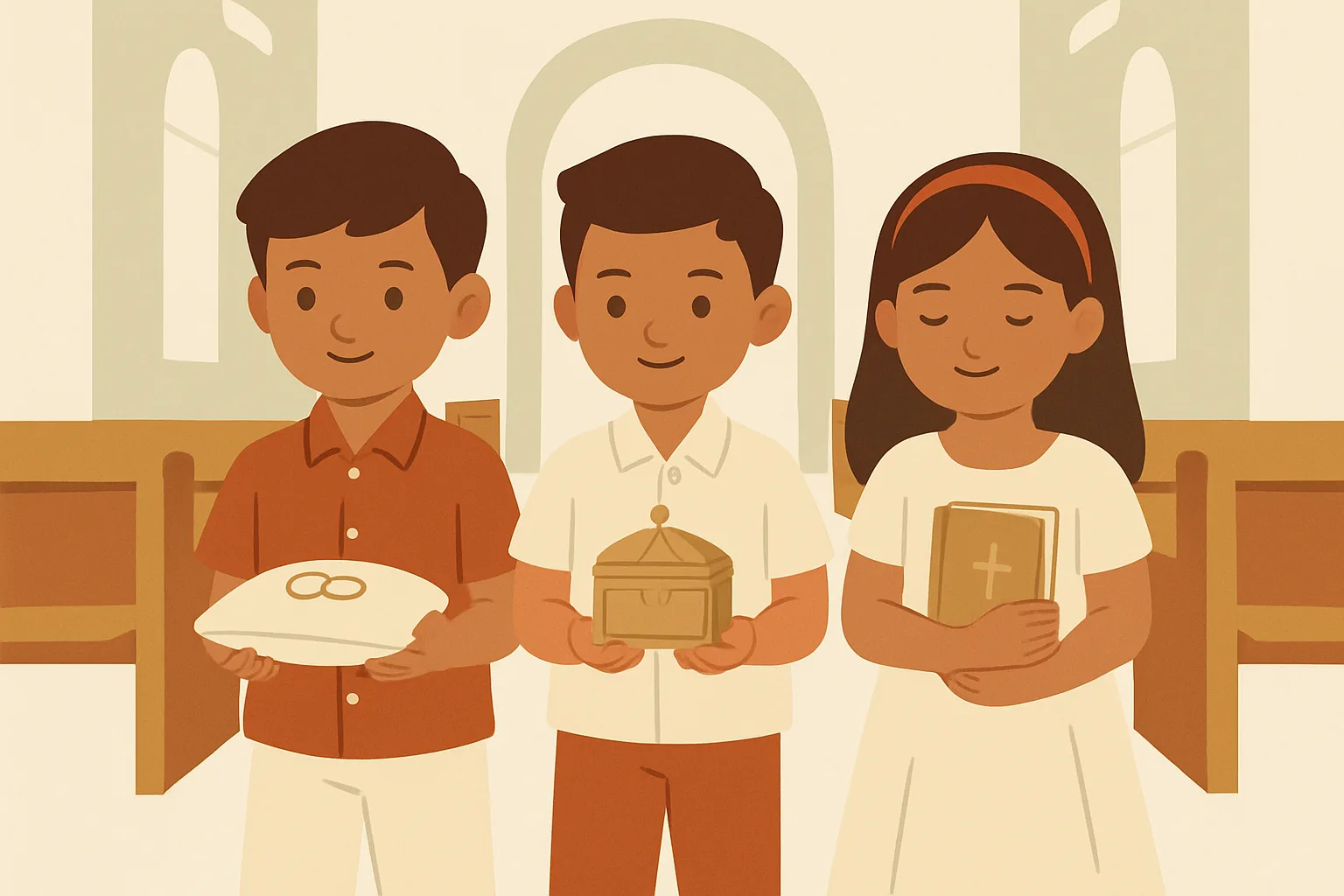
What each bearer carries, and when
| Role | Carries | Used for |
|---|---|---|
| Ring Bearer | The wedding rings, usually on a small pillow | The ring exchange |
| Coin Bearer | The arrhae, traditionally 13 coins, in an ornate basket or pouch in the Philippines (Wikipedia) | The coin rite, where the groom gives them to the bride |
| Bible Bearer | "Carries the bible used in the wedding ceremony" (Nuptials.ph) | Not specified by these sources |
Nuptials.ph describes all three as the entourage's "traditionally younger members", each "in charge of carrying some of the items that will be used in the ceremony" (Nuptials.ph).
Arrhae meaning: what the 13 coins stand for
Arrhae (pronounced "ar-rah-heh", per Seiyaku) are the wedding coins the coin bearer carries. They are not peculiar to the Philippines. The table sets out what the sources say.
| Question | Answer | Source |
|---|---|---|
| Other names | Las arras, arras, wedding tokens, unity coins | Wikipedia |
| Where the word comes from | Spanish "arras": earnest money (arrhae is the plural of arrha), bride price or bride wealth | Wikipedia |
| How many | 13, gold or silver coins in the Filipino tradition | Nuptials.ph |
| Older reading of 13 | The twelve months of the year, plus the poor as the thirteenth | Wikipedia |
| Current reading of 13 | Jesus and the twelve apostles | Wikipedia; Seiyaku |
| What giving them means | The groom's promise to provide, and the bride's trust in his ability to | Wikipedia |
| When in the ceremony | After the rings; the priest blesses the coins first | Wikipedia (customs) |
| What holds them | An ornate basket or pouch in the Philippines; a box or chest in Spain and Latin America | Wikipedia |
| Real money? | May be real currency or specially struck tokens | Seiyaku |
| Church status | An optional element "important in Hispanic and Filipino families" | For Your Marriage |
Sources differ on direction. Wikipedia and Nuptials.ph describe the groom giving the coins to the bride, while Seiyaku says arras were "both given and received in a spirit of reciprocity". Wikipedia also says scholars trace the custom to Visigothic law, Frankish marriages and ancient Rome, and that an English text was approved for the Catholic order of marriage in 2016 (it cites Fox News Latino). Seiyaku's order of service also lists the arrhae among the optional elements after the ring exchange, and its arrhae page includes a blessing of the coins. Ask your priest which reading your parish uses. The coins are a pledge between the couple, not a gift from guests, and separate from the reception money dance in our guest guide.
How old should a bearer be? Sources do not agree
There is no single rule, only a range and one archdiocese's recommendation.
| Source | What it says | Applies to |
|---|---|---|
| Nuptials.ph | "Traditional bearers are usually little boys around three to nine years old." Adult bearers are fine too | Filipino weddings generally |
| Bride and Breakfast | "Usually, bearers are within the age range of three to eight years old" | Filipino weddings generally |
| Zola | "Typically, the age range for a ring bearer is between four and 12" | Ring bearers, US-focused |
| Archdiocese of Palo | Advises child entourage members, including the "arrhae bearer, Bible bearer", be "already of ages seven (7 years old) and above" | This archdiocese's own weddings |
| Weddings in the Philippines | Many churches set "requirements on minimum age, as well as having received the sacrament of Holy Communion", with no number given | Parish-dependent |
The Archdiocese of Palo's figure is one archdiocese's recommendation, not a nationwide Church rule. If a bearer's age is close to any of these lines, ask your own parish.
Nuptials.ph also says bearers need not be boys: "It's OK to have a female bearer." It lists the usual picks as "nephews, little cousins, godsons, or the sons of the bride and grooms friends", or the couple's own child (Nuptials.ph).
Real rings or dummy rings
The rings are safer than couples fear, because the ring bearer usually is not carrying the real ones. Nuptials.ph: "Since ring bearers are traditionally young boys, dummy rings are used to avoid losing the actual rings. The real rings are with the best man for safekeeping." It adds that the ring bearer's walk is "mostly ceremonial". One source complicates this: Bride and Breakfast's maid of honor list has the maid of honor holding the groom's band during the pre-vows. Weddings in the Philippines likewise advises fake rings for the ring bearer, with the real ones kept by the best man or another trusted person, though it suggests handing the rings to an old enough ring bearer just before the procession. Agree who holds what at the rehearsal. Our duties guide sets the best man's and maid of honor's jobs side by side.
The coin bearer is different: per Wikipedia, unlike the ring bearer, the arrhae-bearer "carries the actual arrhae in its case on a cushion". None of these sources describes a dummy-coin or dummy-Bible practice. What happens once the three reach the altar is not covered either, so settle it with your officiant or coordinator at the rehearsal.
Where the three bearers walk
Kasal.com lists the traditional processional order (Kasal.com):
- Best Man
- Groom with his parents
- Principal Sponsors
- Secondary Sponsors
- Ring Bearer, Coin Bearer, Bible Bearer
- Flower Girls
- Bridesmaids and Groomsmen
- Maid/Matron of Honor
- Bride with her parents
Its recessional runs bride and groom, then the flower girls and the bearers (marked "(optional)"), then the maid of honor and best man, then the bridesmaids and groomsmen. Bride and Breakfast's 2024 processional guide puts the bearers in the same relative slot and adds that "variations occur, often influenced by personal preferences, family dynamics, and the physical layout of the wedding venue". Our ceremony order guide shows where the coin rite falls.
Attire and keeping a young bearer calm
Our barong and Filipiniana guide covers attire for every role, including a sourced row for each bearer. Our own suggestion, not sourced from the above: dress a young bearer for comfort over a full afternoon, in colors that match the entourage.
Weddings in the Philippines notes that for Catholic weddings, "the flower girl and the ring bearer are not part of the Rite of Marriage and are thus optional." Its advice for the children who do walk (source):
- Have the child try on the full outfit, including shoes, before the day.
- Practice the walk with props such as baskets or small pillows, even in a church other than the venue.
- Show a video of another bearer or flower girl walking.
- Make sure the child has eaten and slept beforehand.
- If a parent is elsewhere in the entourage, have someone the child knows stand in front or coax the child along.
- Never force a child to walk; if all else fails, walk down the aisle with the child or carry them.
How bearers appear on your invitation
On an Imbitasyon Ko invitation the three bearers print under one shared heading, "Bearers", with names underneath. The individual labels (Ring Bearer, Coin Bearer, Bible Bearer) appear in our entourage list maker and on printed inserts, not on the invitation page. Our entourage layout samples show the group order. On the Free plan the public page shows only the first 10 entourage entries in the order entered, so add the bearers early if your list is long.
Three small roles, sources that disagree on age, and one practical step: ask your own parish before you lock in who carries what.
Frequently asked questions
What does arrhae mean in a Filipino wedding?
Arrhae, also spelled arras, are the 13 wedding coins the groom gives the bride after the priest blesses them. The exchange stands for his promise to provide for his family and her trust in his ability to do so. The word comes from Spanish for earnest money.
What do the 13 coins in a wedding represent?
The older reading is the twelve months of the year plus the poor as the thirteenth coin. Today the 13 coins are commonly read as Jesus and the twelve apostles. Wikipedia reports both readings; Seiyaku gives the apostles reading.
What does the coin bearer do?
The coin bearer carries the actual arrhae in its case on a cushion, according to Wikipedia, unlike the ring bearer. Nuptials.ph says ring bearers usually carry dummy rings instead. Wikipedia says the coins are presented in an ornate basket or pouch in the Philippines.
How old should a ring bearer be in the Philippines?
Sources disagree. Nuptials.ph says three to nine, Bride and Breakfast says three to eight, Zola says four to 12, and the Archdiocese of Palo advises age seven and up. Ask your own parish, because some churches set a minimum age.
Does the ring bearer carry the real wedding rings?
Usually not. Nuptials.ph says dummy rings are used to avoid losing the actual rings, which stay with the best man, and the ring bearer's walk is mostly ceremonial.
Do you need a ring bearer, coin bearer and Bible bearer?
No. Weddings in the Philippines says the flower girl and ring bearer are not part of the Rite of Marriage and are optional for Catholic weddings. The Catholic rite outline also lists the arras as an optional element.
Who walks first in the processional, the bearers or the flower girls?
In Kasal.com's traditional order the ring, coin and Bible bearers walk after the secondary sponsors and before the flower girls. Bride and Breakfast places them in the same relative slot and says variations are common.